
Punch, cut and bend
Submitted by:
Sara Waddington
Removable partition and pod designer, Cerenn Industrie, has increased its panel production by 180 panels per shift and reduced its energy consumption, cycle times and scrap rates with a new FMS line from Salvagnini. We outline how in the September 2026 issue of ISMR.
===
At its plant in Sarre-Union, France, Cerenn Industrie designs, manufactures and markets removable steel partitions with high acoustic performance for the French and European markets. In this demanding production environment, technical performance, aesthetics, fire compliance and installation speed must coexist within extremely tight tolerances.
As Vincent Limagne, Technical Director, Cerenn, explained: “We must adapt to each project and create variants to meet customer requirements for installation configurations and aesthetics. To guarantee aesthetics, quality and technical performance at the same time, every millimetre counts.”
These requirements explain why automation has long been central to the company’s industrial strategy. In 1992, Cerenn installed its first automated Salvagnini S4+P4 line, transforming the way its production was organised. This flexible manufacturing system punches, shears and bends sheet metal continuously and automatically, without any intermediate manual handling.
Jehan Pelletier, Process & CAM Manager, Cerenn Industrie, recalled: “We reached 120 panels per shift, while reducing scrap by 30%. We gained repeatability, productivity and process stability.”
A flexible manufacturing system
After more than thirty years of operation, however, the original machine tool installation was reaching its limits. Stéphane Massing (Plant Manager, Cerenn Industrie) summarised the new challenges: further reducing waste, increasing responsiveness and more easily producing small batches, sheet by sheet. “We wanted more automation and a technology capable of better integrating our production constraints,” he said.
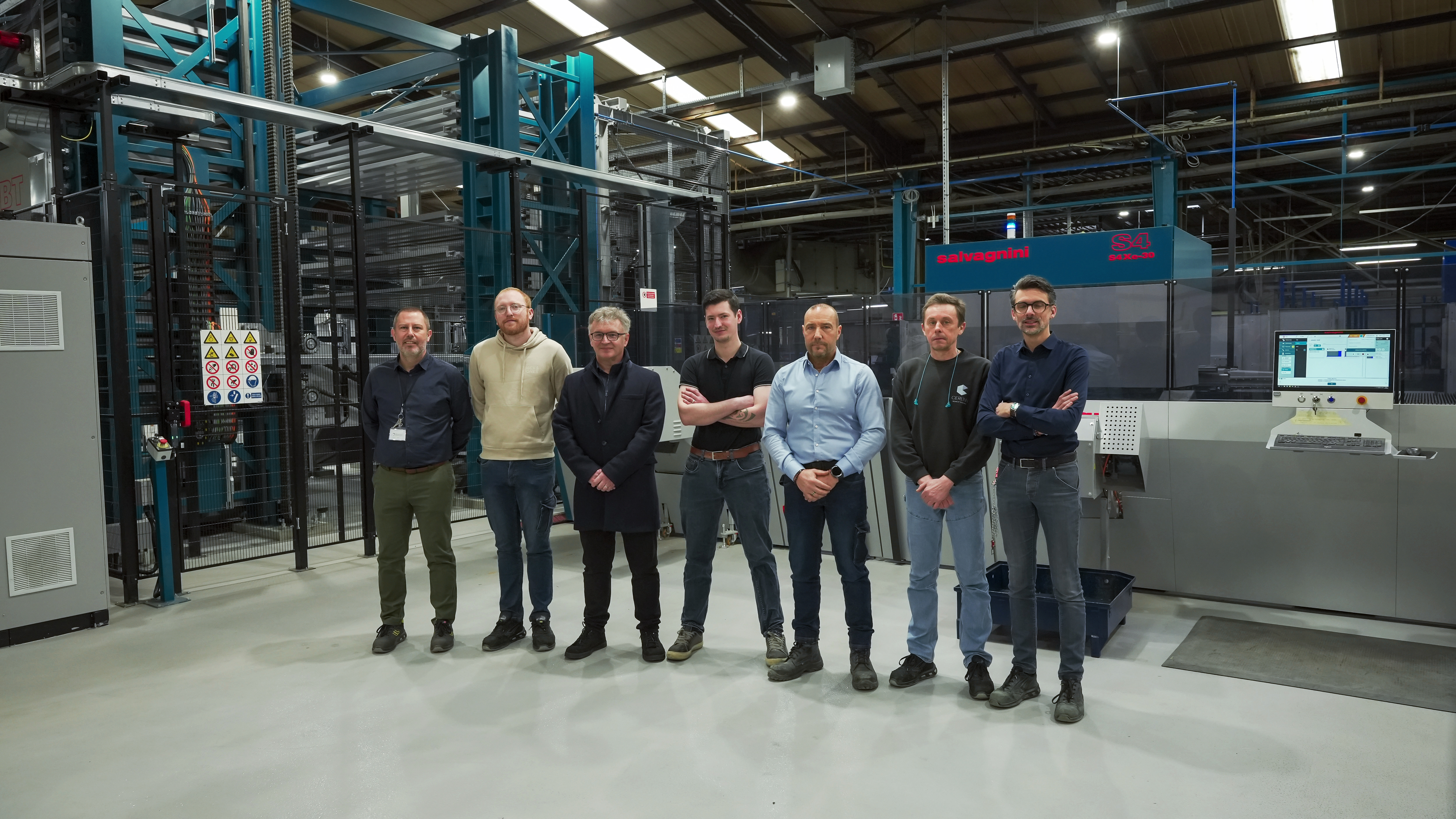
The new installation is based upon a Salvagnini flexible manufacturing system integrating MBT bi-tower store, SMD, S4, MCU and P4. Together, these machines form a continuous, autonomous production chain designed to optimise flow and strengthen production capacity. The MBT can accommodate up to around thirty pallets, totalling nearly 90 tons of raw sheet metal.
“The new S4 punching machine retains the principles of the previous generation while delivering significant gains in speed, versatility and acoustic comfort. Combined with the MCU, the system now enables continuous production with buffer stock management and unmanned operation over the weekend,” confirmed Italian sheet metal specialist, Salvagnini.
For bending, Cerenn installed a P4-3220 panel bender featuring the P tool, CLA auxiliary blades and the CUT option (for sequential, in-cycle separation cuts on sheet metal). With a maximum bending length of 3,200mm, the machine combines automatic handling, single centering and universal bending tools to help ensure precision and repeatability.
This configuration further extends production possibilities. CLA blades enable partial bends, the CUT option allows sequential cutting on the same sheet and the P tool facilitates the creation of complex geometries.
“The new P4 introduces a new way of bending, with undeniable speed and features that now allow us to create bends within the panels themselves,” highlighted Jehan Pelletier.
“The integration of CUT also unlocks new productivity opportunities. The line can now process small parts from a single sheet, successively performing bending and cutting in one cycle, at a level of speed and complexity previously unattainable,” continued Salvagnini.
“The evolution also involves the software. Our solutions improve integration between the design office and the workshop using the STREAM programming suite and OPS software, which manages production lists from ERP/MRP systems in real time, as well as sequencing and part tracking. This approach is particularly suited to Cerenn’s flexible production environment,” it added.
To read the rest of this article in the September 2026 issue of ISMR, see https://joom.ag/Ozfd/p24