
A bending philosophy
Submitted by:
Sara Waddington
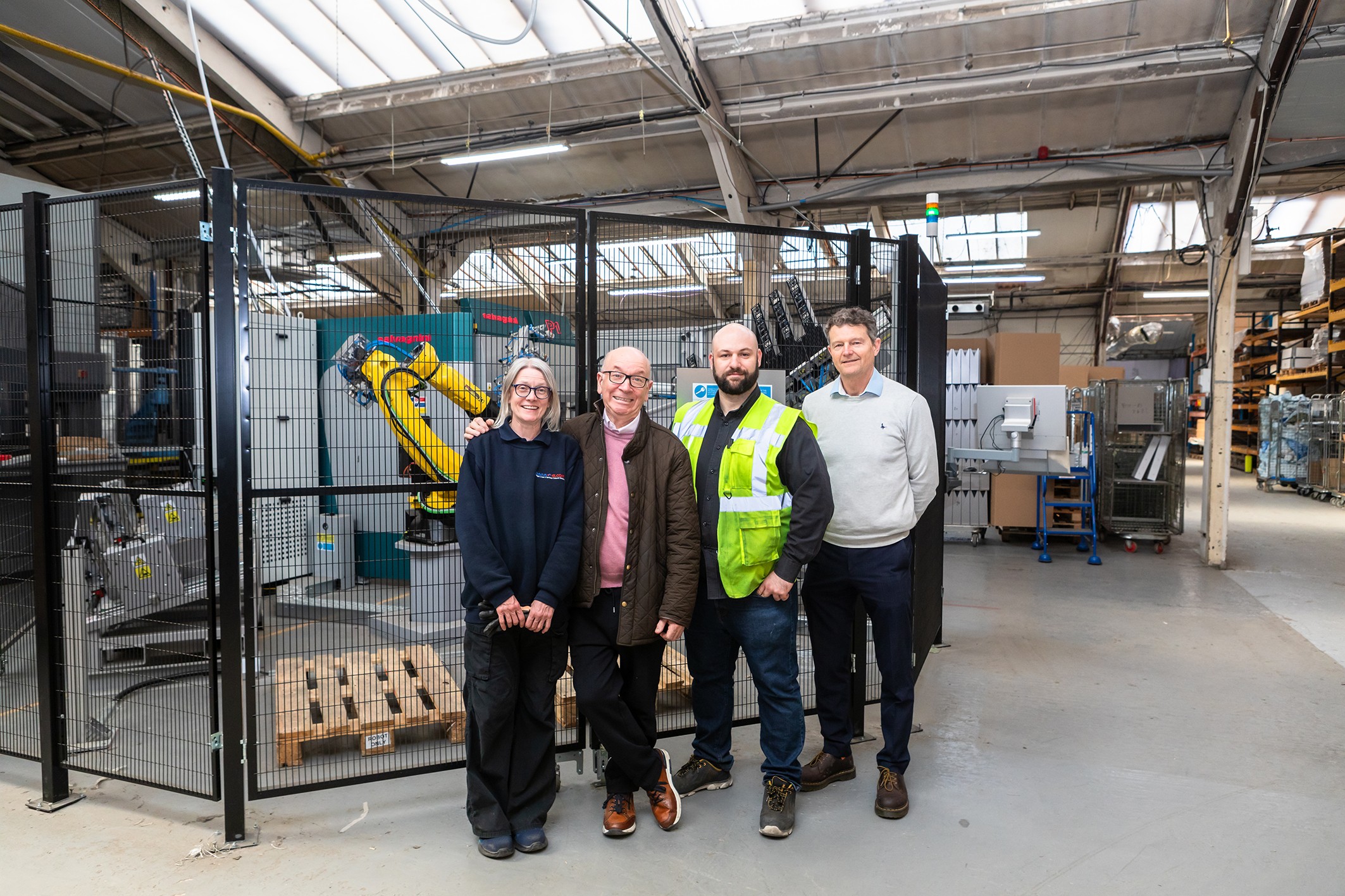
(Image: The Penn Elcom team in front of its new robotised bending cell.)
Penn Elcom has increased its productivity and efficiency by adopting a robotised bending cell, as well as new panel bending and press brake technology.
====
With a global footprint, strong product culture and a no-nonsense approach to production, Penn Elcom has grown into a manufacturing specialist in 19” racking systems, flight case hardware and specialist enclosures. But behind the scenes, a quiet revolution has been reshaping its UK factory floor, now driven by Salvagnini’s automated bending technologies.
Founded in 1974 and known for its robust flight case hardware and 19-inch racking solutions, Penn Elcom is a British manufacturing company with an unconventional mindset. Its Hastings plant (part of a global network that includes operations in China, the United States and Europe) has undergone a profound transformation from traditional metal bashing to advanced, flexible manufacturing powered by Salvagnini bending technology.
Today, supported by a worldwide network of sales and distribution depots, Penn Elcom manufactures and delivers thousands of components monthly to over 70 countries for sectors ranging from entertainment to self-storage and e-commerce.
Rethinking production
But it wasn’t always this way….
“I used to think of us as metal bashers,” admitted Roger Willems, Chairman of the Board. “We had power presses, hard tools, more machines than we could count. It worked—but it wasn’t scalable and it wasn’t smart. We had as many as 14 press brakes at one point. But even with all that capacity, we still couldn’t keep up with demand. We were chasing volume with labour. We knew it wasn’t sustainable.”
The solution, as it turned out, wasn’t just more machines. It was a different way of thinking about sheet metal.
Penn Elcom had made its first steps into automation with punching and laser systems. However, bending remained a bottleneck. The complexity of managing tool changes, operator variability and long set-up times made press-brake productivity highly dependent upon skilled labour that was becoming increasingly hard to find and train.
Faced with this labour shortage, growing demand and shrinking lead times, Penn Elcom needed to find a more efficient, flexible production model.
“We knew that we had to reduce manual handling, improve consistency and increase throughput,” explained Rafal Parda, Managing Director, Penn Elcom. “But more than that, we wanted to create a system that was future-proof, capable of scaling with the business and responsive to any product change.”
At the time, Penn Elcom was operating over a dozen press brakes. But traditional bending methods could no longer keep up. What the company needed was a technology that could eliminate set-up times, standardise quality and decouple production from labour variability.
To read the rest of this article in the December 2025/January 2026 issue of ISMR, see https://joom.ag/X3Ed/p36