
A sheet metal vision
Submitted by:
Sara Waddington
ISMR attended TRUMPF’s INTECH exhibition in Germany, where market opportunities, threats and challenges, as well as new machinery, connectivity and software innovations, were highlighted for sheet metal manufacturers.
===
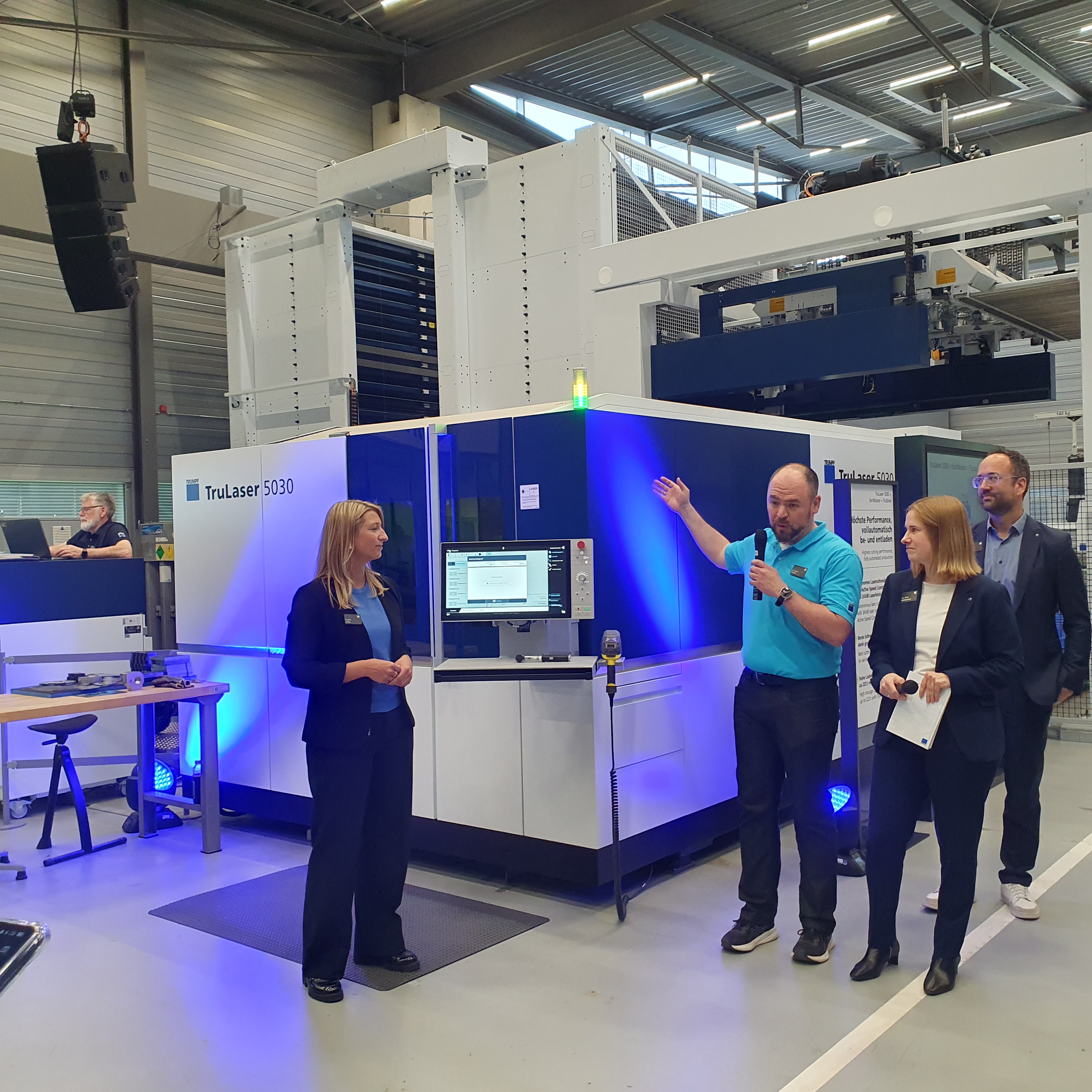
At its four-day INTECH in-house exhibition (21-24 April 2026), sheet metal giant TRUMPF welcomed thousands of customers, partners and colleagues from all over the world to its headquarters at Ditzingen, Germany. From high‑throughput laser cutting and efficient 3D processing to entry‑level machines and new growth opportunities in data centre manufacturing, it showcased how to make production ready for the future. New technologies, machinery, software and artificial intelligence/connectivity advances were demonstrated in TRUMPF’s Customer Centre at Ditzingen. ISMR was invited to the event.
“From cutting, bending and welding to connected manufacturing solutions, INTECH is the place to be to discuss concrete use cases. Visitors from all over the world experienced our technologies live and in real applications to see how they can make a difference in production. INTECH is more than machines, however. It’s about exchange, dialogue and partnership. Our experts were on-site to listen and challenge ideas to find the right solutions together. The event featured presentation, guided tours, panel discussions, happy hours and the Friday brunch,” the company explained.
TRUMPF was at the Tube trade show in Duesseldorf the previous week, where it launched its new, more productive TruLaser Tube 7000 laser tube cutting machine. With nine kilowatts of laser power, the machine processes greater wall thicknesses using nitrogen as its cutting gas.
TRUMPF is one of the technology and market leaders in machine tools for flexible sheet metal processing and industrial lasers. It offers consultancy, platforms and software to its customers. In 2024/25, the company generated revenue of 4.3 billion euros with 18,303 employees. With approximately 90 subsidiaries, the group is represented in nearly all European countries, in North and South America, and in Asia. Production sites are in Germany; France; the United Kingdom; Italy; Austria and Switzerland as well as in Poland; the Czech Republic; the United States; Mexico and China.
An eye on AI
At the press conference during INTECH, Stephan Mayer (CEO Machine Tools, TRUMPF) and Hagen Zimer (CEO Laser Technology, TRUMPF) briefed journalists (including ISMR’s editor) from across Europe. They outlined how companies can differentiate themselves from the competition and tap into efficiency gains. Machine safety, artificial intelligence (AI), data centres and robotics all came under the spotlight.
Despite the economic downturn, geopolitical challenges and resulting uncertainty in the market, Hagen Zimer highlighted TRUMPF’s ongoing efforts to improve the safety, quality and utility of its products.
“To differentiate ourselves from competition, we have developed products that offer higher productivity, quality and utility for our customers. This is where we find our niche. We also aim to continuously launch new innovations into the market. Innovation is key: we need to be offering products that others do not yet have,” he said.
Stephan Mayer agreed and emphasised TRUMPF’s focus on its customers. “We aim to make our customers successful. It is important that the equipment we offer them proves what it promises in terms of output and uptime. Service is very important – rapid response, spare parts availability and our ability to monitor the equipment performance in the field. AI (artificial intelligence) brings us additional capabilities to ensure the maximum uptime and productivity of TRUMPF machines. Connected service solutions ensures efficient maintenance of the machines. That means a lower cost per part, which is crucial for our customers. This is how we differentiate ourselves,” he explained.
TRUMPF uses AI internally for repetitive company tasks and processes (e.g. automation of admin, spare parts orders, translation of operator manuals etc.). This has considerably accelerated processes and, confirmed Hagen Zimer, freed TRUMPF’s workforce for “more creative tasks.” It also uses AI in its products and software for applications such as vision and recognition (e.g. for sheet metal part sorting), predictive maintenance and machine service. At INTECH, the company demonstrated its robotic AI vision system for sorting laser-cut sheet metal parts.
AI, said Mayer, “is a tool to help us solve problems, become more efficient and increase the uptime of our customers’ machines.”
TRUMPF now gives its service engineers an AI ‘assistant’ to help them check the database for similar issues and quickly diagnose any machine issues. AI also performs predictive maintenance to eliminate bottlenecks or machine breakdowns e.g. by deciding when oil needs to be changed in a TRUMPF machine. Data monitoring and cloud connectivity in machinery is crucial for this.
“There are also downsides to AI, of course. The upsides, however, are objectivity; infinite memory; the ability to manage high-complexity tasks on the shop floor and high speed,” commented Hagen Zimer. “AI can be fast, quick and precise and we need to use it wherever we can to produce our next generation of products and improve our portfolio. AI can also help us to become more competitive by automating and taking over key tasks such as IT and programming. In a climate of labour shortages, especially as more experienced personnel retire, AI can keep that vital knowledge and skills base intact. The technology is here to stay.”
To read the rest of this article in the May 2026 issue of ISMR, see https://joom.ag/nAKd/p26