
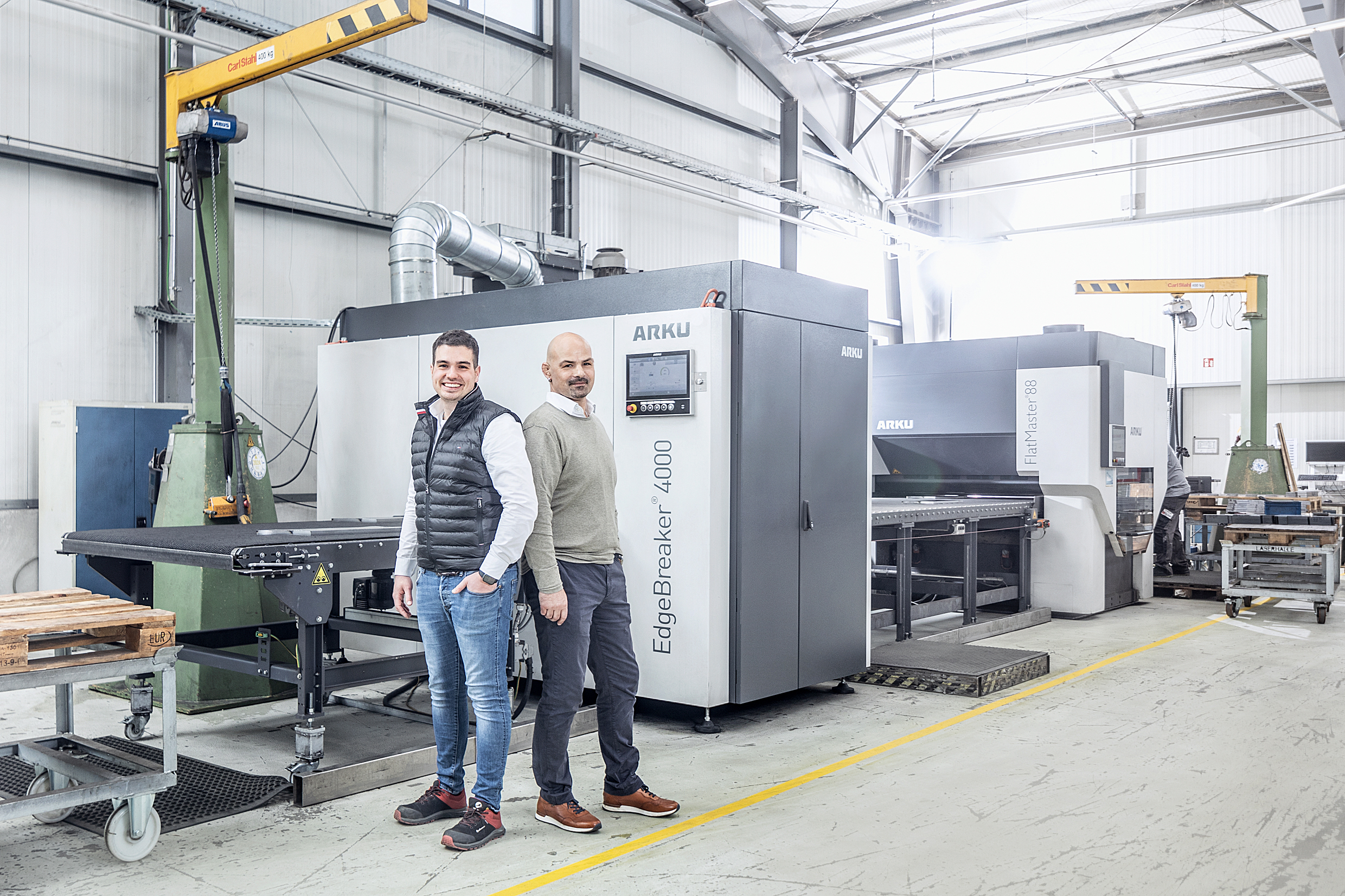
Deburring and levelling at Haller Metall
Submitted by:
Sara Waddington
HALLER Metall’s switch from CO₂ to fibre laser cutting has placed an increasing focus on deburring and levelling operations. By integrating more efficient machinery and processes in these areas, the manufacturer has successfully enhanced its overall product quality while reducing its costs, writes Stéphane Itasse in the March issue of ISMR.
====
HALLER Metall GmbH in Pönning, Germany, is an example of how a metalworking supplier can achieve growth. Starting as a repair shop for agricultural machinery, it is now a mid-sized company with 250 employees based across two sites. Two machinery systems from surface finishing specialist, ARKU Maschinenbau, have played a key role in this expansion.
HALLER Metall has a key focus on quality. The company, based in Lower Bavaria, has earned an impressive number of certifications and makes use of modern machinery. It now offers far more than metal processing and has expanded its portfolio to include the assembly of complete modules.
In sheet metal and tube processing, the company offers laser cutting of blanks, milling when required and the joining of components into assemblies. An essential part of this capability is a stable of modern machinery that the company consistently keeps updated with the latest technology.
For example, HALLER Metall recently converted from CO₂ to fibre laser cutting systems to better service its customers in commercial vehicle, agricultural machinery, logistics and medical technology sectors.
Flatness and edge rounding
“Our customers are placing increasing value on flatness and rounded edges on cut parts,” reported Markus Heinrich, Technical Operations Manager, HALLER Metall. One reason is that coatings adhere better to burr-free, rounded edges.
The switch from CO₂ to fibre lasers has had a significant impact on production planning, as more parts now require deburring. The flatness of individual parts and the reduction of internal stresses are also crucial in minimizing welding distortion in welded assemblies.
“We and our end customers want to work more efficiently,” said Heinrich. This applies to individual parts, welded assemblies and even final assembly, which becomes easier when flatness tolerances are tighter.
HALLER Metall first contacted surface finishing specialist, ARKU Maschinenbau GmbH, at a trade show.
“We were looking for a new levelling machine,” Heinrich recalled.
To read the rest of this article, see https://joom.ag/bkvd/p40