
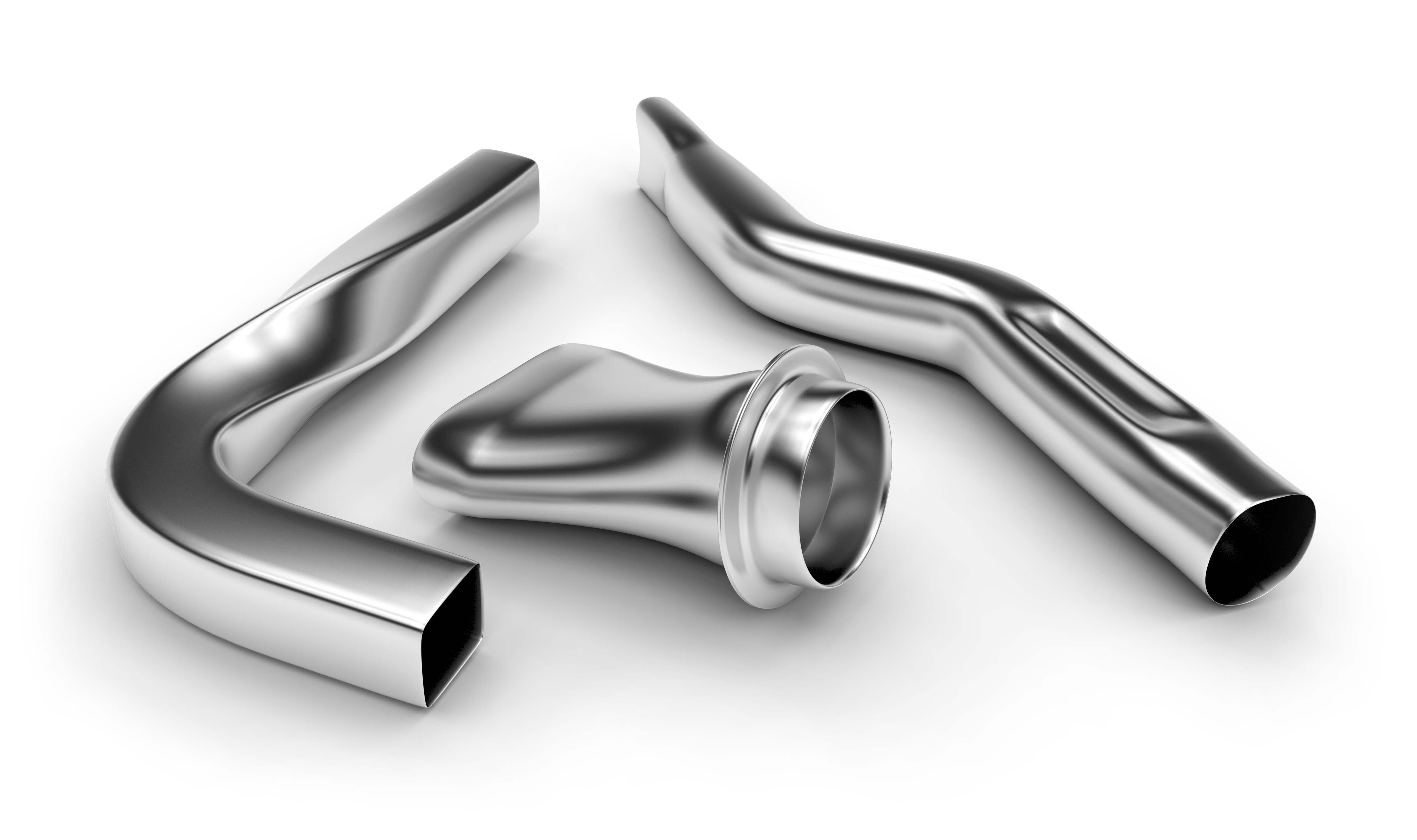
Sheet and tube hydroforming
Submitted by:
Sara Waddington
Both sheet and tube hydroforming processes allow for the seamless forming of new shapes and parts in common metal alloys without welds. In the March 2026 issue of ISMR, we present the applications and benefits of the process for forming a range of metals into complex, lightweight, strong and durable parts.
=====
Hydroforming is a metal fabricating process that can form complex geometries in tubular-based parts and extended deep draws in sheet metal-based parts. Hydroformed parts allow for parts’ consolidation; the reduced number of sub-components reduces assembly costs and increases the strength and stiffness of the final assembly.
The near-net shape manufacturing method uses a combination of fluid pressure and mechanical forces to transform sheet blanks into functional geometries. The process has several benefits such as the ability to achieve deeper draws, more complicated features/complex components and strong metal surface quality. It is a specialised type of die moulding that utilises highly pressurised fluid to form metal. Structural strength and stiffness can be improved and tooling costs reduced because several components can be consolidated into one hydroformed part.
Hydroforming is, in fact, a quick and efficient metal forming method designed to reduce waste while guaranteeing structurally robust parts and components with minimal need for secondary finishing operations. Hydroforming is suitable for shaping intricate, exceptionally complex or asymmetrical/irregularly shaped components (including both convex and concave shapes). The final shape can be achieved in fewer steps and with less manual correction. Heavy gauge and difficult materials can also be formed into complex shapes with close tolerances.
The metal fabrication and forming process enables the shaping of metals such as steel; stainless steel; copper; aluminium and brass. Internal high-pressure forming (hydroforming) is, in fact, a methodology for the manufacture of hollow metal components (a process that has grown enormously since the mid-1990s). There are numerous applications for the process in various industry sectors to manufacture lighter, stronger as well as rigid, one-piece structures. The process is suitable for industries that require intricate and high-quality components (such as automotive, aerospace and electronics).
To read the rest of this article, see https://joom.ag/bkvd/p32