
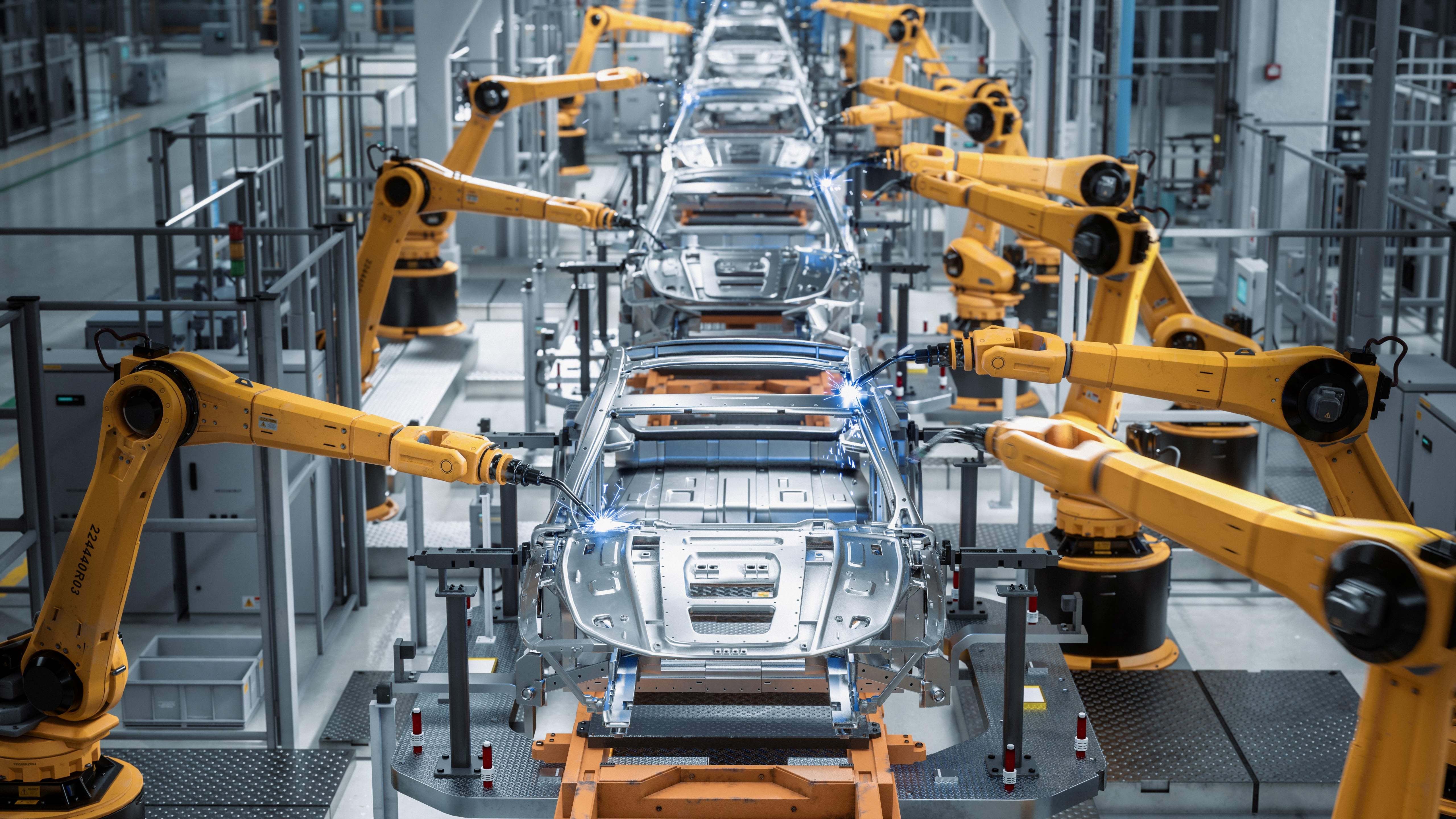
Market trends for industrial robotics
Submitted by:
Sara Waddington
Global market forecasts, key growth trends, changing applications, technology advances and new requirements for industrial robotics come under the spotlight.
====
“The industrial robot market is driven by several factors, such as the rising usage of robots and smart manufacturing processes in industrial sectors which, in turn, leads to rising demand for automated robots and drives growth of the industrial robot market. The rising penetration of Industry-4.0 practices and the growing trend of electric automobiles across the globe also drive growth of the global market,” commented analyst, Fortune Business Insights.
The ‘World Robotics 2025’ statistics on industrial robots, from the International Federation of Robotics (IFR), showed 542,000 robots installed in 2024 (more than double the number ten years previously). Annual installations topped 500,000 units for the fourth straight year. Asia accounted for 74% of new deployments in 2024, compared to 16% in Europe and 9% in the Americas.
Robot density surges in Europe, Asia and Americas
Economies worldwide are prioritising the integration of factory robots, as automation becomes a critical tool for boosting productivity. In the global automation race, Western European countries reached a record 267 robots per 10,000 employees in the manufacturing industry in 2024, ahead of North America with 204 units and Asia with 131 units. This is according to the World Robotics 2025 report, presented by the International Federation of Robotics (IFR).
Robot density is the number of operational industrial robots relative to the number of employees. It can cover the whole manufacturing industry or just specific industrial branches. The number of employees serves as a measure of economic size, so the quotient of operational stock over employees puts the operational stock on a uniform base.
“The robot density metric provides a uniform basis for comparison by relating the total number of robots used in a country to its economic size, as measured by its workforce,” explained Takayuki Ito, President of the International Federation of Robotics.
Robot density by region
According to the IFR, Western European countries recorded a robot density increase of 3% year-on-year. Eight countries are in the global Top 20: Germany; Switzerland; The Netherlands; Austria; Italy; Belgium & Luxembourg; France and Spain. The European Union (EU-27) has a robot density of 231 units, which is above the global average of 132 units per 10,000 employees.
To read the rest of this article in the May 2026 issue of ISMR, see https://joom.ag/nAKd/p34